Showing posts with label deep sh*t. Show all posts

Friday, February 9, 2024

Al, Is That You?


Did you see what Merriam-Webster’s word of the year was for 2023?

“Authentic.”

They could have chosen Artificial Intelligence, “AI” (which always looks like Al to me, like the shortened version of the name Allen or Albert) or “rizz” or “deepfake” but didn’t. Authentic won out, and I think it should have.

I am sure the decision was indeed a way to call out AI and all the ramifications of it. I see AI all the time these days and I, for one, am sort of frightened of it. Others more so; artists, photographers, writers all see it as a threat to their livelihood and creativity. College professors wade through fake papers. Politicians use it to slander and defame their candidates. Phones fix bad backgrounds, eliminate people and objects, even aggregate a number of images into one, fake, image where everyone is smiling.

What frightens me more is the AI we don’t see and won’t see even more in the future as it gets better and better and more nefarious and, well, meaner. I should acknowledge that, as I understand it, AI can be an amazing tool – predicting problems and treatments in medicine, finding anomalies in weather patterns, aiding in the building of those amazing images from the Webb telescope that surprise us seemingly every day, and in so many more ways I am sure I will never know.

And, you know what? There’s another thing I think I should be thankful to AI for – it has sent me on a search for the truth, the actual, the authentic.

I ask myself, more than ever, perhaps even for the some of the first times in my life, is this real?

That’s profound and exactly what AI is designed to not have me do.

I listen to a lot of new music, mostly Americana, Folk and Bluegrass, and am finding a new voice coming through it all, a true voice, a real story, a new authenticity and, honestly, I think a lot of folks are looking for that as well.

At The Grammy Awards last Sunday there was a lot of big, big stuff – costumes and choreography and songs from artists I don’t know and never will – none of it AI (I assume) but, for me, fake, somehow digital. And then…

Enter Tracy Chapman, analog, a guitar and an iconic song, Fast Car, and then, Luke Combs joins her and I am holding back tears. The crowd roared; the show stolen.

And then, and then…

Joni Mitchell comes out with her beautiful helper and friend, Brandi Carlisle, and sings Both Sides Now in a spinning throne-like chair and her walking staff and re-steals the whole damn show. Imagine, a woman – a young woman – writes a song in 1966, records it and it becomes a huge hit. (I remember my dad loved it and the song’s been echoing about in my mind for decades.) She records it again, a lavish production, in 2000. And then, she sings it again in 2024 – a frail and beautiful woman, strong and tender and so, so lovely. I let my tears run…

…as they are now.

In an opinion piece in The Washington Post just yesterday, Kim Ruehl writes: “I felt these things again as I watched Tracy Chapman and Joni Mitchell sing their songs. At its best, a song can remind us there is light on offer every day. After the past few years of world events, it still feels as though we are emerging from our tiny cabins. We are pretty sure we know what to expect. But then the light comes — just like that. With it come the tears. We didn’t know how much we needed them.”

Ms. Ruehl wasn’t the only one to mention these two performances, out of the dozens Sunday night – journalists and artists, friends and so many others could not help but marvel, comment and revel in the confelicity that we all shared, the joy.

What we saw was authentic.

What we witnessed was the truth.

We saw unadulterated beauty.

It is not surprising that, in this world of AI and deepfakes and this maelstrom of untruths, many of us saw and savored this moment, humans are better than it all, I swear.

Originally when this all started, (when? I don’t know, it just kind of seeped in, didn’t it?) I was angry and distrustful and vowed to not fall for it and eschew it at every opportunity, and not allow it in my life.

Well, that’s not going to work out and life upsets me enough already.

But something else happened, I look harder now for the authentic.

Go on out now and look for it and yourself, you’ll see it.

A little league baseball game.

A high school musical.

The lyrics to this new song or that old one.

The poems of our tender sons.

The tears of a lover lost.

The stone truth in a memory turned to the sun.


Look for it.


AI can simply not compare to the brushstrokes in a Rothko painting, the story in a Norman Rockwell, the images of Mapplethorpe, the detail in a Vermeer. It cannot compare to “To be…” or "When he was nearly thirteen my brother Jem got his arm badly broken at the elbow..." and all that comes after those lines. It shall never even hum to Brahms’ German Requiem, Bohemian Rhapsody or an American in Paris. It could never conjure the folk dances of the indigenous or put on the slippers at the Bolshoi Ballet.

It can never get to the truth of it all, this Art.

Seek that truth. Seek that place. Seek that, well… Love. Like the Tinman of Oz, you can see its heartlessness and will never get one. It simply… can’t.

There is no Artificial Love.


Tuesday, August 17, 2021

Leather Journals and Weathered Campers

This piece was originally publish in City Dads Group in July of last year. There is an added paragraph that was edited out (for good reason, it's weird) included at the conclusion. I just wanted this here in my blog-cum-journal because it means a lot to me and I want it with my other musings.


I am going through a long and sentimental (bordering on mawkish) ending of sorts that involves a 20-year-old Coleman pop-up camper.

My wife and I bought it new just after we were married, well before we had the twins, well before I ever dreamed that was on the horizon. It’s old and worn now, ravaged by time and memory, many miles and many backyard sleepovers. I am trying to figure what to do with it as it’s barely roadworthy.

We were so delightfully young and naive when we were purchasing it. We spent weeks looking at floor plans, considering size and amenities, finally deciding on a smaller sized one that could be towed by my six-cylinder Chevy S-10. A smaller size would also made it a little easier to back up and, truth be told — ‘cause I suck at backing a trailer — could actually be hand pushed into a space when necessary. It never really occurred to us that we might be camping with twin toddlers or giant teenagers, so we based our needs on just us: no toilet and an interior set up to accommodate two newlyweds and a guitar.

The camper’s been in the backyard for sometime now. The boys like to hang out in it as the WiFi reaches that far. I’ve got to put it down before … well, I can’t.

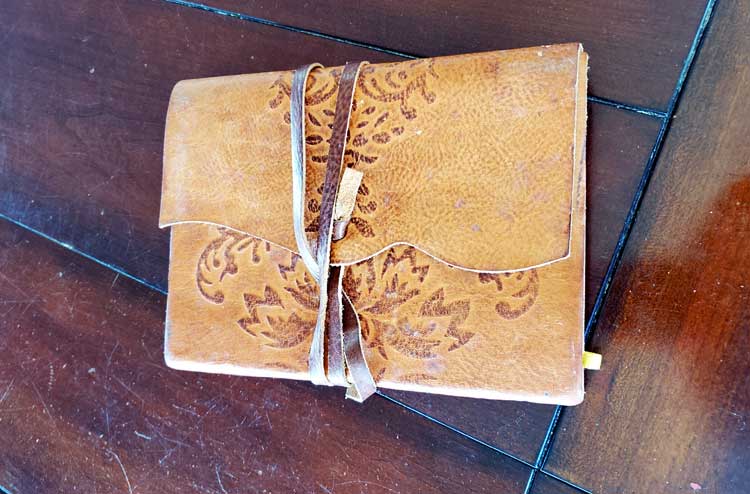
You see, at the same time we bought the camper, I purchased a very nice leather-bound journal. I put it in a drawer inside the camper and vowed to write a bit about every night we would spend in it. And I did. The writing is not very good, few metaphors or deep insights, but the years are covered, each trip dutifully noted. Through the pages, the boys grow up, I age, the relationship with my wife deepens and a continuity and connection is established. Over the years, it has held the stories and hopes of a young family growing up together. Stories of thunderstorms and frightened toddlers, scraped knees and sleepless nights; hopes for the future in the young minds of 6-year-olds and my own hopes for their lives moving forward.

leather bound journal
“Through the pages, the boys grow up, I age, the relationship with my wife deepens and a continuity and connection is established. Over the years, it has held the stories and hopes of a young family growing up together.” (Photo: Bill Peebles)

I am very glad I bought that journal. It sits to my left as I am writing this right now.

I spent a couple of recent evenings in the old camper, looking through what was in it when I came across the journal. I, of course, knew it was in there, but with a curious urgency — fueled perhaps by the beers — I put it with the pile of things to take into the house along with a nice bag of ropes and twine and three fire-starter type lighters — you know, the long ones.

Here’s the thing, the “ending” of that old camper is a new “beginning” for that journal. It is done with its long present and now can begin to show me my past: a past where I hoped for my boys’ future. It is so strange how, as one writes in diaries and personal journals, how prescient we can be. There’s an entry from 2011, written of an early morning at a state park in central Ohio, where I say: “The boys are getting along surprisingly well. They rarely fight or bicker and are good friends, it seems. Who knows how long that’ll last, but I really hope it does.”

How could I know then that, nine years later, they’d still be best friends?

Or, that at the time I was watching the beginnings of what I think will be a lifelong friendship?

How, perhaps, would I know that camping and close proximity and bonding in the close quarters of that little camper would help that along?

And how, perhaps I had helped it through sheer happenstance and in a leather-bound journal I’d noted it and can now look back upon it?

Recently, a fellow father and writer, purchased a used camper and solicited advice from a social media group we are in. I typed a long answer — advice on gear and the such — but I deleted it. The real advice I had for him was too ethereal and came from a place I’m at now, a place he’ll get to, a place he already is. Camping, like so many other family adventures and hobbies, are about memory making. Their worth can only be revealed later, but, at the time you’re making them, you still somehow know that even if you don’t realize it then.

Anyway, we all seem to be currently living lives that seem to simply be in the present.  Asking ourselves to consider what is ahead, or even close examination of what was just behind us is, if you’ll forgive me, untimely.  Literally, now, this now, is not the time. But, for me, this journal seems to be both future and past, a thing long gone, but ultimately to show its future self, uh… later?  Now?

Oh, nevermind…


Wednesday, May 20, 2020

A Sideman's Dream


Do ya’ll know what a “sideman” is? I looked it up and I didn’t get a good feel for the word: “a supporting musician in a jazz band or rock group.” That’s really not enough, but I am sure I have layered my own connotations over this simple meaning, as one does.

When I was in my early teens, I tried to learn some Jim Croce songs since he was in the fashion of the times. “Operator,” “I’ve Got a Name” and “Time in a Bottle” are just a few of the tunes I tried to mimic.
I got them down alright, but I never really mastered them. I just assumed I didn’t have the skills to do them.

And then, in the late seventies, I saw Jim perform on a variety show with another guy. I was all, who’s that dude, and, as I watched, I came to understand he was doing the guitar heavy lifting and Jim was just strumming the rhythm. The realization came over my adolescent-addled mind like a storm, one of those, oh, ohhh, OH! moments. Yes, of course, I should have figured it out, but I hadn’t.

He was a long-haired, lanky guy named Maurice T. "Maury" Muehleisen. In fact, here they are together in what I think is the very show I was watching a repeat of. He was killed in the same plane crash that killed Croce and others.

 Jim Croce

After the initial surprise, and, honestly, the shocking fact that I didn’t know this, I watched on. Besides the extraordinary fingering skills and the airy background vocals and the absolute calm he exuded, I could not help but notice how damned happy he looked, as though he couldn’t get over the fact that he was playing for a legend, as though he felt honored to be doing it. That stuck with me.

Forward now ahead to the last few years. I’ve taken a strong interest in the songs and legends of the inimitable Guy Clark. I guess you could say I studied him and his music. I read a wonderful authorized biography of him by Tamara Saviano called Without Getting Killed or Caught: The Life and Music of Guy Clark. I watched a bunch of videos, many from his later years, and one fellow kept coming up, Verlon Thompson. I won’t go into the details of times and places; they aren’t necessary today.

But what is important is how he felt about his job. Over and over again, he states that it was the great honor and joy of his life to be Guy’s sideman. You can tell he means it as well. He took Guy’s death awfully hard, as you can imagine. He also wrote this song, “Sideman’s Dream” for Guy.

I did a lot of living between Maury and Verlon, but I’m not sure I was ever very far away from the idea of a sideman, a helper, a supporter, a “lifter” if you will.

I worked in restaurants for most of my life as a busboy, a waiter, and a bartender. I came early to the conclusion that my job was not about me, but to make others shine.

I never tried to upstage my guests, I always tried to make the whole experience about them. I cannot lie, this approach worked well, and I made a lot of money because of it. Others in the business, however, often were the star of their own show. Beautiful flirty waitresses, flamboyant gay waiters, Canadian dudes with “outrageous French accents”, stuffy sommeliers, overly enthusiastic hostesses and semi-celebrity chefs - they all fill the dining rooms of my memory, and I am sure their own styles worked well for them, but, it never felt genuine to me.

I spent most of my career in fine dining establishments most of which utilized a system of front- and back-waiters, especially for larger parties but often just on a regular night. In most cases, both could perform either role, but I preferred being a back-water. The front-waiter usually did all the talking and gave the “spiel” and took the order, though it helped if both remembered it, and basically ran the show.
The back-waiter took care of all the little details. When a guest left the table, I folded his napkin and, upon their return placed back in their lap. I made sure the Missus had a fish fork and the Mister a steak knife. I kept the water and wine glasses full, removed the salad or soup course, helped serve the entrees and lifted the cloches, and kept the whole thing rolling so the front waiter could look as cool and effortless as possible.

I loved it. I was useful and helpful and had every opportunity to be kind. I enjoyed the elegance and grace of it all. It was very dignified.

And there, I think, might be my point. There is dignity in every line of work that we all must recognize. I don’t want to list all the jobs that I think don’t get the dignity and appreciation they deserve - fabricate your own list - but I know everyone deserves my respect. Are there exceptions? I suppose so, maybe… not really.

In all those years back-serving I often was asked by a guest why I wasn’t a front-man, their assumption being that there was a hierarchy and that I seemed pretty good at it all. I’d smile and deflect, saying it was a pleasure to work behind John, Heidi or Sebastian or whoever. I never felt it stick in my craw though. We split the tip evenly and the work sharing seemed fair, so I just felt we were so-workers, team-workers.

Which, it occurs to me, might be a better point. No role is in any way subservient if it’s agreed upon that the goal and outcome serve the mutual need.

I return to Maury and Verlon and so many other great sidemen I’ve noticed over the years. After the initial thrill of the front-man and the excitement of a favorite song, I find my eyes and ears drifting to the sideman. A great guitar lead or a soaring fiddle solo, the studied beat of the drummer, the bassist soft and slow, the pianist’s quick arpeggio - all seem to lift the front-man, raising him higher than their singular talents. This would be the outcome of serving the mutual need: To present the song as perfect as possible.

One last, quick story and I’ll let you go.

I sometimes play and sing in a local bar called The Plain Folk Cafe of a Thursday night, open mic night. Now, I could write a novel about what I’ve observed in the goings-on there, but what most strikes me is the level of decency everyone offers each other. And these are different folks, with different geographical and social backgrounds, “hillbillies and hippies” my friend Ron once said. But this is no place to start a novel…

I know his name, but I haven’t asked him if I could use it (I didn't think Ron would mind), and, as a memoirist, I might not have all my facts correct or may have assumed things in my subjectivity that aren’t there. Anyway, he plays harmonica and is remarkably good. He sometimes sings and plays guitar but mostly he the house harmonica guy. Folks invite him up to play or he’ll play a bit as someone’s doing their set and they’ll ask him up. Which is what happened to me.

I was playing a tune, “Paradise” I remember, and I heard this plaintive call coming from close in the crowd, I saw him and motioned him up. He grabbed his harp case and hopped on up, playing the whole time, I might add. I’d really just started the song so after the second chorus I played a verse and chorus just on the guitar. A head bob to him and he understood instantly and took the melody on his harp. 

He soared. Adding more, in all honesty, than I would in the subsequent verses. He found that lonesome, lost sound that mirrored the mood and sad beauty in those haunting Prine words. I was a bit gobsmacked and I think he was, too, at me giving him such a long solo, I barely knew him at the time.

I finished that song and did a few more ending with a song I’d written called “In a Little Boy's Soul”. Mind you, he could never have heard this song before, guaranteed. One chorus and verse in, he was playing it like he’d know it all his life. He really lifted my song, made it shine brighter. I will be always indebted to him for that.

We got off that stage and do you know what he said? “Thanks for letting me play with you. I truly enjoyed that.” And then he thanked me for giving him that lead and telling him what key the songs were in. He’d just transcended my set, made it better, you understand? He made it better. I thanked him, of course, and complimented his style and connectedness but he’d have none of it, genuinely humble.

He started to the bar to get a fresh Yuengling and I thanked him one last time, and then he said something that still echoes, “It was my honor.”

So, I guess that’s my advice today. Sometimes, you’ll be a sideman, sometimes you won’t, (and sometimes you just won't be sure), but I have found the most satisfaction in being one. 

I am a sideman to you boys. 

I am a sideman to my dear wife, Marci. 

I’ve been a sideman to friends and musicians, chefs and CEOs, infants and the infirmed, priests and roofers.

And it has been, and shall forever be, my honor.

Peace and thanks for stopping by, I know things are pretty tough the days, I appreciate your time.


There's always more, isn't there?  Years ago, over ten I'd say, Marci had this mouse pad made for me. It's Zack holding the water fountain on as Nick gets a drink, they later reversed roles.


 It's nice to have a sideman, ain't it boys?